
Fixed assets with finite useful lives are depreciated by systematically allocating their depreciable amount over the periods in which the business expects to use them. Depreciation affects reported profit but does not necessarily reflect changes in an asset’s market value. Straight–line depreciation is the simplest and most widely used way to do it.
Why Depreciation Matters for a Hong Kong SME's Accounts
Allocating an asset’s cost across its useful life provides a more accurate reflection of profitability than expensing the full amount immediately upon acquisition. Fixed-asset depreciation shows up in both your statutory accounts and your management reports, and it is something owners, directors and bookkeepers should all understand, not just the accountant preparing year-end figures.
Understanding the Straight-Line Method of Depreciation
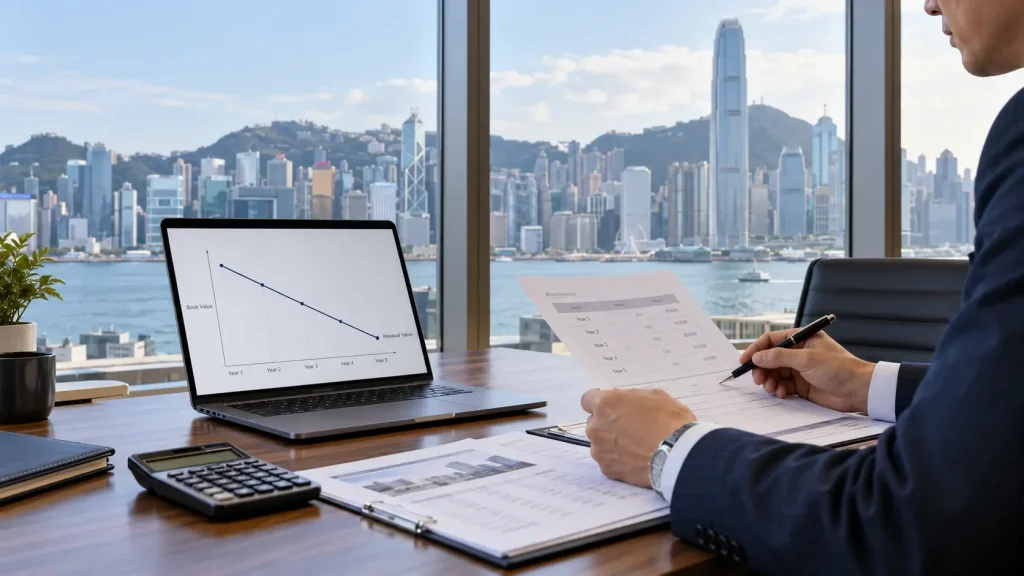
The straight-line method charges an equal amount of depreciation to the income statement every year of an asset’s useful life. Single-line depreciation is simply another name for the same approach, and its even, predictable charges are what set it apart from front-loaded write-down methods.
The Depreciation Formula Behind the Straight-Line Approach
The core depreciation formula is: (Cost – Residual Value) ÷ Useful Life. To calculate it step by step:
- Identify the asset’s total cost, including purchase price, delivery, and installation fees.
- Estimate the residual value, which is the amount you expect to receive when you dispose of the asset at the end of its useful life.
- Determine the asset’s useful life in years based on how long you expect it to provide economic benefits.
- Subtract the residual value from the total cost to find the depreciable amount.
- Divide this depreciable amount by the useful life to arrive at the annual depreciation expense.
You can also use the built-in SLN function in Excel, which requires these same three inputs to automate the calculation.
Cost Basis, Residual Value, and Useful Life for Hong Kong Companies
An asset’s cost includes its purchase price plus duty, freight, and installation. Residual, or salvage, value should be estimated realistically rather than assumed at zero, and useful life should be set sensibly under HKAS 16 rather than copied from a generic table.
Worked Examples of Straight-Line Depreciation in Practice
Office furniture and fit-out costing HK$300,000 with a HK$0 residual value over 6 years depreciates at HK$50,000 a year. A company van costing HK$400,000 with a HK$40,000 residual value over 6 years depreciates at HK$60,000 a year. Computers and IT equipment typically carry shorter useful lives, and part-year charges apply when an asset is bought partway through the year.
Recording Straight-Line Depreciation in Your Accounting System
The monthly or year-end journal debits depreciation expense and credits accumulated depreciation. A fixed-asset register that stands up to audit scrutiny, kept current alongside HKFRS-compliant software, saves real time when the auditor arrives. Recording additions, disposals and useful-life changes as they happen, rather than reconstructing the register at year-end, is what keeps the schedule audit-ready year after year.
How Financial Reporting Depreciation Differs from Hong Kong Profits Tax
Book depreciation under HKAS 16 is not deductible for Hong Kong profits tax at all. Instead, the IRD grants an initial allowance of 60% on qualifying plant and machinery in the year of purchase, plus an annual allowance on a reducing-value pool at 10%, 20% or 30% depending on the asset class, with a balancing charge or allowance when the asset is eventually disposed of. Certain prescribed fixed assets — including computer hardware and software, and environmentally friendly vehicles and machinery — qualify for an immediate 100% deduction instead, a point many overseas guides miss entirely.
Deferred Tax: The Bridge Between Your Accounts and Your Tax Computation
Because book depreciation and IRD allowances run on different tracks, they create the timing differences behind deferred tax — covered in full in our deferred tax guide.
Straight-Line Versus Other Ways to Depreciate an Asset
While the straight–line method spreads costs evenly, other approaches may suit different assets better. For instance, reducing-balance and double-declining-balance methods front-load depreciation for assets that lose value quickly in their early years, while the units-of-production method links depreciation to actual usage rather than time, making it ideal for machinery with variable output.
When the Straight-Line Method Is the Right Choice for Your Business
Assets that lose value steadily, like furniture and fit-out, suit a level charge well. Assets that fall in value fast, like some IT equipment, may call for an accelerated method instead. Weigh the asset type against your reporting needs before committing. Consistency matters too: switching methods for the same asset class year to year makes it harder for anyone reading your accounts to compare one period against the next.
FAQs
Is Straight-Line Depreciation Accepted for Hong Kong Profits Tax?
Book depreciation itself is never tax-deductible; only the IRD’s own depreciation allowances apply for tax.
What Assets Can I Depreciate, and Which Ones Can't I?
Property, plant and equipment with finite useful lives is depreciated once it is available for use; land generally does not.
Does Depreciation Reduce My Company's Cash or Just Its Reported Profit?
It is a non-cash charge — only reported profit is affected, not cash.
Can I Change My Depreciation Method or Revise an Asset's Useful Life Later?
Yes, but the change and its reasoning should be disclosed in the accounts.
Should an SME Owner Handle Depreciation Alone or Use an Accountant?
An accountant helps ensure the figures hold up under audit and align with IRD rules.